
Technical Bid vs Financial Bid: How Tender Evaluation Works
What Is a Technical Bid and a Financial Bid? How Tender Evaluation Actually Works
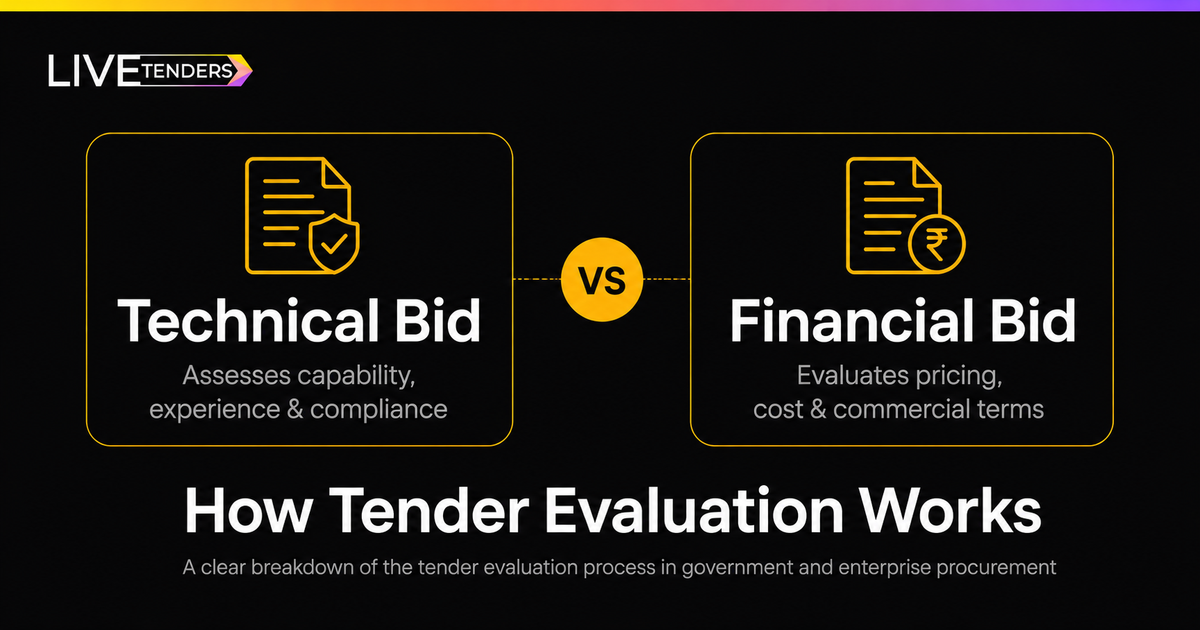
Every government tender gets evaluated in two separate stages: a technical bid and a financial bid. Clear the first, and the second gets opened. Fail the first, and your pricing never even gets looked at, no matter how competitive it was.
Most bidders who lose tenders don't lose on price. They lose before price is ever considered.
The technical bid: proving you can actually do the work
This is where the buyer checks whether you're qualified to execute the project at all, separate from what you'd charge for it. Typically this includes:
- Company registration certificates and relevant licenses
- Past project experience, usually backed by completion certificates
- Your proposed methodology, work plan, and resource allocation
- Proof of equipment or machinery ownership where relevant
- Quality assurance and safety procedures
Here's the part that catches experienced bidders off guard: rejection at this stage is almost never about competence. It's about paperwork. A completion certificate that's missing a signature, an equipment ownership document that expired last quarter, a methodology section that's vague where the tender wanted specifics. The company was qualified. The submission wasn't.
The financial bid: priced, but not always won on price alone
If you clear the technical stage, your financial bid gets opened. This includes your quoted price, a detailed Bill of Quantities (BOQ), and the breakdown of material, labor, overhead, taxes, and GST that justifies that number.
How it gets evaluated depends on the method the tender specifies:
L1 (lowest bidder wins): The most common method for straightforward goods and works tenders. Whoever clears the technical bar and quotes the lowest price wins, full stop. Technical score doesn't carry forward into this decision beyond the pass/fail threshold.
QCBS (Quality-cum-Cost Based Selection): Both your technical and financial scores get combined into a weighted total, common splits are 70:30 or 80:20 in favor of technical quality. This is used for consultancy-heavy and quality-sensitive work, and government guidelines cap how much weight the non-financial score can carry, generally up to 30 percent, and typically for contracts under a set value threshold. Under QCBS, a bidder with a strong technical score can beat a lower-priced competitor who barely scraped past the technical minimum.
Knowing which method a tender uses before you price it matters. Treat a QCBS tender like a pure lowest-price contest and you'll either overprice yourself out of the technical advantage you earned, or underprice a bid that didn't need to compete on cost alone.
Why the order matters more than people think
Fail the technical stage and your financial bid is typically never opened at all, sealed and returned. That means a brilliant, competitive price never gets seen if your documentation had a gap. The reverse also costs you: a technically flawless submission with a poorly calculated price still loses, or worse, wins at a margin that doesn't cover your actual costs.
The bidders who consistently win aren't the ones who are best at either stage individually. They're the ones who treat both as equally worth getting right, every time, not just on the tenders that feel important.
Where this actually breaks down for most teams
The documentation gaps that get bids rejected usually aren't a knowledge problem, they're a tracking problem. Different tenders want past performance proof formatted differently, different portals have different document upload rules, and when you're juggling several live bids at once, it's easy for one submission to go out with last quarter's completion certificate instead of the updated one.
LiveTenders helps here by giving your whole team one shared workspace instead of each person tracking their own tenders separately. You can save and sort tenders by deadline or category, and set up an AI agent with your own keywords and requirements that runs continuously and flags relevant tenders the moment they're published, so nothing gets rushed together at the last minute because nobody noticed it earlier.
Book a demo to see how it fits into your bidding workflow.
Frequently Asked Questions
What is a technical bid in a government tender?
A technical bid is the part of your submission that proves you're capable of executing the project, covering registration, past experience, methodology, and equipment, evaluated separately from your price.
What is a financial bid?
A financial bid is your priced proposal, including the quoted cost, a detailed Bill of Quantities, and the tax and overhead breakdown behind that number. It's only opened after you clear the technical stage.
What's the difference between L1 and QCBS bidding?
L1 awards the contract to the lowest-priced bidder who clears the technical minimum. QCBS combines technical and financial scores into a weighted total, so a stronger technical proposal can outweigh a lower price from a competitor.
Why do bidders get rejected at the technical stage even when they're qualified?
Usually documentation gaps, not lack of competence, missing certificates, expired proofs, or a methodology section that didn't meet the tender's specific requirements.