
How LiveTenders Streamlines Your Tender Workflow
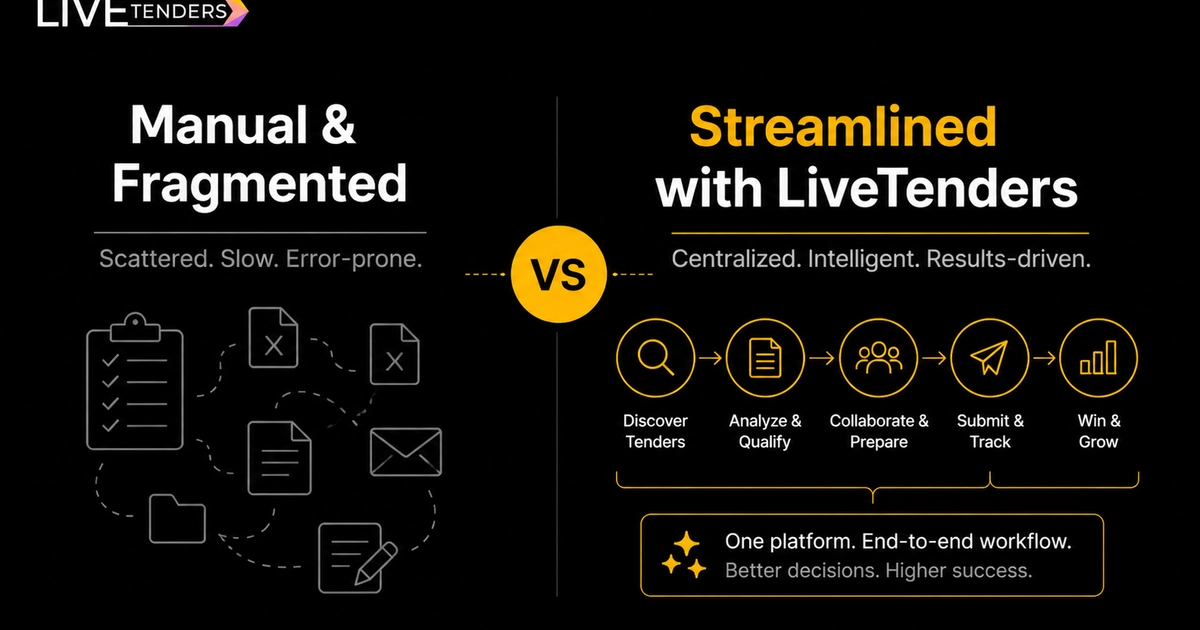
How LiveTenders Streamlines Your Tender Workflow
Most tender teams aren't losing bids because they lack capability. They're losing time, and eventually tenders, to a workflow that was never actually designed as one: someone checks a few portals in the morning, forwards anything relevant over email or WhatsApp, someone else tracks deadlines in a separate spreadsheet, and nothing lives in one place until it's already urgent.
Here's what that actually looks like once it's consolidated.
Discovery: an AI agent instead of manual searching
Instead of your team logging into each portal and searching manually, you set up an AI agent once with your own keywords and business criteria, category, location, tender value range, whatever actually defines a relevant opportunity for you. From there, it runs continuously in the background, checking sources around the clock, not just whenever someone remembers to look.
The practical difference: your team's time shifts from searching to reviewing. Instead of hunting for tenders, you're evaluating the ones already surfaced and matched to your business.
Tracking: a shared workspace instead of scattered spreadsheets
Once a tender is found, it needs somewhere to live that the whole team can see, not just the person who found it. LiveTenders gives you a shared workspace where tenders get saved and sorted by category, deadline, or whatever structure fits how your team actually works.
This solves a specific, common failure: tenders don't usually get missed because nobody saw them. They get missed because one person saw them, meant to forward it, and didn't, or forwarded it to the wrong person, or it got buried in an inbox by the next morning. A shared workspace removes that single point of failure.
Collaboration: your team working from the same view
Bringing your team into the same workspace means discovery, review, and bid preparation happen against a shared, current view instead of each person working from whatever information they personally received. That matters more as a team grows, coordination overhead increases faster than headcount does, and a shared system is what keeps that from compounding into missed handoffs.
What this changes in practice
None of this replaces the actual work of preparing a strong, compliant bid, that still takes real expertise and effort. What it removes is the time spent on the parts before that: searching, forwarding, re-checking, and hoping nothing slipped through. The result is more of your team's actual working hours going into the bids you've already decided are worth pursuing, instead of the process of finding them.
Book a call to see the workspace and AI agent set up against your specific categories.
Frequently Asked Questions
How does the LiveTenders AI agent actually find tenders?
You configure it with your own keywords, categories, and business criteria, and it runs continuously across government, PSU, and private tender portals, surfacing matches automatically instead of requiring manual searches.
Can multiple people on my team use the same LiveTenders account?
Yes, LiveTenders is built around a shared workspace where your team can save, sort, and review tenders together instead of one person managing access alone.
Does LiveTenders write or prepare the actual bid for me?
No, LiveTenders focuses on discovery and team tracking, finding and organizing relevant tenders. Preparing the technical and financial bid itself remains your team's work.
How is this different from just setting up email alerts on a government portal?
Portal alerts typically cover one source and require manual filtering. LiveTenders' AI agent checks multiple sources continuously and matches against your specific criteria, and the results live in a shared workspace instead of an individual inbox.